
Blue Man Group Boston: October 1995 - July 2025: an Affectionate Farewell to a Crunchy Little Place in a Big World Going Too Smooth
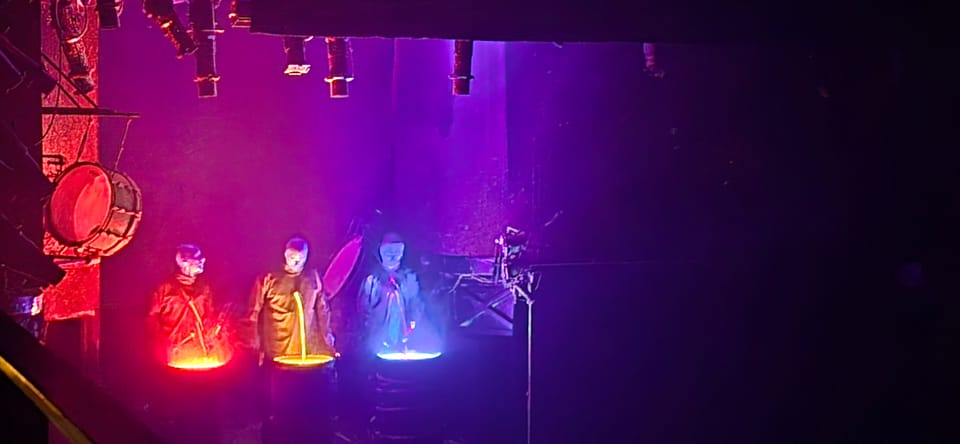
In the old days, if you attended the 10pm show on New Year’s Eve at Blue Man Group in Boston, the regular show would wrap up at around 11:40 and you’d be invited to stay in your seat to welcome in the new year. The house staff would make their way through the theatre, giving out little plastic flutes of champagne to any adults who wanted some and sparkling cider to children and non-drinkers, then the Blue Men would come back out, take up their paddles, and play ‘Auld Lang Syne’ on their signature PVC pipe instruments before everyone counted down to a toast at midnight.
The 10pm show in those years was usually decently well attended, but never sold out, so for several years, you could find me and other staff members coming off of shifts in the side balconies for this extra after-show celebration. Then the audience would file out into the chaotic streets of First Night in Boston, and the staff - performers, stage crew, house staff, box office, managers, anyone who worked in the building - would gather in the lounge on the first floor for a party.
I rang in - how many? six? seven? eight? - new years in this way before the 4pm/7pm/10pm schedule permanently morphed into a 2pm/5pm/8pm schedule, counting in the year from a corner of the balcony after closing up the box office and submitting the financial reports for the show, and stopping by the Lounge for the party afterward.
Last week, I attended a special friends-and-family performance marking the final week of Blue Man Group Boston’s almost-30-year run. I saw Blue Man Group the first week it opened in Boston on an outing for a friend’s birthday; I saw it a few days ago, in its closing week; and right through the middle of that three-decade span, I worked there for 13 years.*
The pay was never good, as in any workplace some of the people I worked for over the years were truly awful, and the box office itself was a cramped cubby under a staircase that got nightmarishly hot in summer. I started there in a brief stint as a phone operator - a job I found on Craig’s List (because it was 2005 and you could do that sort of thing there then) that was mainly attractive because I lived next door at the time and needed a second job - before moving to the box office where I worked part time for a while; then full time while I went to grad school and for a few years after when it turned out my grad degree would not yield me a job in my field after all; then part time again, acting as the box office’s Saturday manager for most of my last several years there.
I loved most the days when I was in charge of closing the building for the night. The closing routine meant a walk around the empty theater, top to bottom, back to front, switching off all the lights, checking that all the doors were locked, and making sure no one was left in the building. Some people find empty theatres spooky, but there’s always been a comfort to me in them. I mean, any theatre worth its salt that has some history has ghosts - and the building currently known as the Charles Playhouse (or the Chuck, to its friends), which has in its 186 years been a church, a synagogue, a speakeasy, a nightclub, and a theatre, to name a few of its identities, certainly has plenty of history - but a theatre has ghosts the way a nest has birds or a warren has rabbits. There’s no menace in it, and they give a richness to the silence when there is no one else around.
Up the front steps from the lobby all the way to the balcony; check the lighting booth and stage management booth; down the back stairs behind the stage; make sure the lock on the emergency exit to the side alley is engaged; pass the green room, the laundry; flip off all of the light switches as you go; wander by spin paintings from performances past, the big canvas with the paint impression of a human form, walls covered in untold layers of neon spatter and blue grease paint marks; loop down through the lounge; tug on the back door; pop out across the other alley to see if anyone is still at work in the trailer out there, locking the door that leads there from the lounge if not; finally, leave out the front door, giving each handle on the front of the building a tug to make sure the locks have clicked into place.
Many of the other staff in the building found real community in this place. They stayed on for years or in some cases decades, part of a family. It was never quite that for me - I was friendly enough with most people and made a few true friends, while never really feeling like part of the club - but I liked being around a lot of the people there, and I liked getting to know all of the theatre’s crooked staircases and odd little cubbies. It was still a place that felt like home to me for a long time, enough that I wanted to be there for this farewell.
And truly, it was like the high school reunion I’ve never attended. So many familiar faces (and mostly I even remembered their names). So many people I was genuinely happy to see, and in turn so many people who seemed happy to see me, far more than I expected. Catching up with people, sharing hugs and hellos, I realized I have now known some of these people for two decades, and even for a bit of an outsider like me, that kind of history means something. Seeing this one last special version of the show with them was moving to me in a way I did not quite expect.
It struck me as I watched that Blue Man Group, almost 40 years from its original incarnation, has remained very much of its time, perhaps to some degree in spite of its own efforts. A performance art piece originally launched in 1987 with an event called the “Funeral for the 80s,” Blue Man Group theatrical show was about looking at everyday things with fresh eyes, about sticking your hands into things and tapping them and throwing them and breaking them and squishing them, about looking at whatever was around you like you were new here. They updated the show every few years to keep up with tech, with the changing media landscape, but something in its DNA resisted modernization.
There always remained something analog about it, something late-20th-century, an indelible ethos of physicality and peering into the guts of things. It was messy, it was tactile. Now, in an era of tech billionaires and AI attempting to smooth, to “optimize,” all of the actual living out of life, the Blue Man was still there in his body, putting his hands, his eyes, his mouth on the mundane, looking to chop it, to mold it into another shape, to make it into something new. There is a distinct loss in its end, and not just to the people who made it happen, to whom it meant so much.
When I heard the show was closing, I was initially sad mostly on behalf of my friends who still worked there and those for whom it was family, but I find I am sadder than I expected for my own sake to see it go. More than 13,000 shows into its run in Boston, I watched the performance last week thinking it would be fitting for the show to close with one more round of ‘Auld Lang Syne’ on the PVCs like those New Year’s Eve shows did.
It didn’t, but the actual ending, with the Blue Men silhouetted against a neon-bright screen, arms raised, was perhaps more fitting, rescuing me from my more maudlin tendencies and letting us all celebrate one last time that stubborn, messy, analog spirit of creation and re-creation, a rough, chaotic spirit we have all the more need to keep space for in a world fighting to sand it down.
*In case this matters to anyone, staff for the show actually worked for a few different companies. ‘Back of house’ (everyone who worked directly on the creation and production of the show - the cast, stage management, company management, stage crew, lighting, sound, props, etc.) all worked directly for Blue Man Group. ‘Front of house’ (everyone who worked for the venue, on the more customer experience side of things - venue management, box office (where I worked for most of my time there), ushers, house managers, phone operators, etc.) all worked for several different companies over my 13 years due to mergers, sell-offs, corporate splits, etc. Management of the bar was contracted out to a separate company, and security was contracted out to another.